SUMMARY
The Coordinadora Estatal de Comercio Justo (CECJ), Spain’s national Fair Trade network platform, used to collect its member organizations’ social audit data in spreadsheets.
We implemented Show your Heart, a free software social audit tool, to automate calculations, centralize data collection and save weeks of manual work.
PROJECT DETAILS
Area
Social Audit, Impact Reporting, Transparency
Services
Development, data migration, automation, infrastructure, training and documentation
RESULTS
- Automated calculations and fewer errors
- Member data in one shared workspace
- Weeks of work saved in every reporting cycle
FREE SOFTWARE STACK
Language
Core library
Framework
Javascript
Vue.js
Nuxt.js
The problem with spreadsheet-based social audits
Fair Trade is a global movement and an alternative trade model that seeks economic, social and environmental justice in international trade.
The Coordinadora Estatal de Comercio Justo (CECJ) is a state-wide organization that articulates the 31 Spanish Fair Trade organizations. Members must show that they meet the CECJ’s accreditation and membership standards and renew their accreditation every two years. The CECJ then uses the same data to publish an annual impact report on the state of Fair Trade in Spain.
Until now, the social audit ran on spreadsheets, with a separate tab for each type of organization and instructions written into the cells themselves. Responses were copied into a consolidated spreadsheet, and from there into a third one to build the charts. The process was slow and tedious.
According to Paula, project officer at the CECJ, the process involved:
- A reporting cycle lasting several months, from data collection to publication of the impact report
- Extensive manual work reviewing and verifying data with each member organization
- A consolidated spreadsheet that was hard to maintain, since it had to be updated by hand every year
The CECJ knew of other social and solidarity economy networks that had already digitized their social audits with Show your Heart, such as REAS, so they decided to streamline their own data collection too.
How we implemented Show your Heart and what we built
Show your Heart is a free software tool built specifically for networks of organizations to run their social audit — also known as a social balance sheet: an assessment of their social, environmental and economic impact. Free software means that any network can install it or ask for improvements.
The platform covered most of the CECJ’s needs, but not all of them. For example, their original forms collected different types of data — text, quantities, percentages — in a single table, which Show your Heart’s codebase did not support.
Together, we decided to expand the project’s scope to build what was missing:
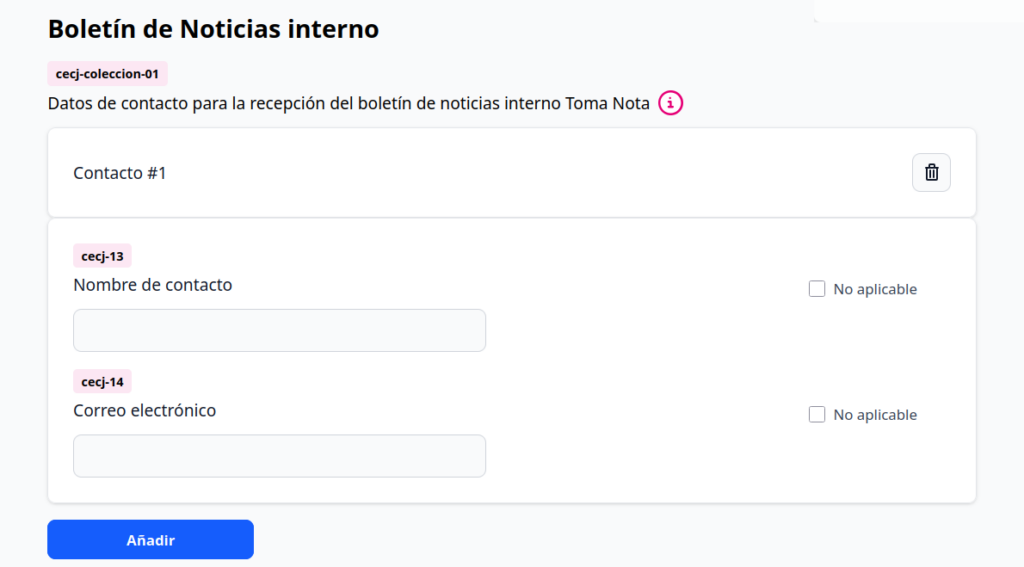
- Data collections, which group all the information about, for example, a single product into one block.
- Tables with automatic totals, to eliminate manual calculation errors.
These features were added to the Show your Heart code repository under a free software license, so any network that adopts the platform can benefit from them.
As part of the implementation, we also:
- Designed custom forms for five types of member organization
- Created a simple user guide and a recorded training session to help members get started with the tool
This was truly a collaborative effort. The CECJ team reviewed their own consolidated spreadsheet in depth and wrote a document explaining how it worked. Without that knowledge, the project would not have been possible.
“amoved was quick to offer solutions that work: simple, but not simplistic.” — Paula, project officer at the CECJ
Results: Fewer errors, less manual work
The CECJ launched its first social audit cycle on Show your Heart in July 2026. These are some of the benefits the team identified in our project review call:
- Fewer calculation errors: key calculations are automated, and the form flags errors and inconsistencies.
- A shared workspace: the CECJ team and member organizations can work on the data in real time and review it together.
- Historical data tracking: information is stored, so no one has to start from scratch each cycle.
- Faster impact reporting: automation cuts several months off the time needed to write and publish the report.